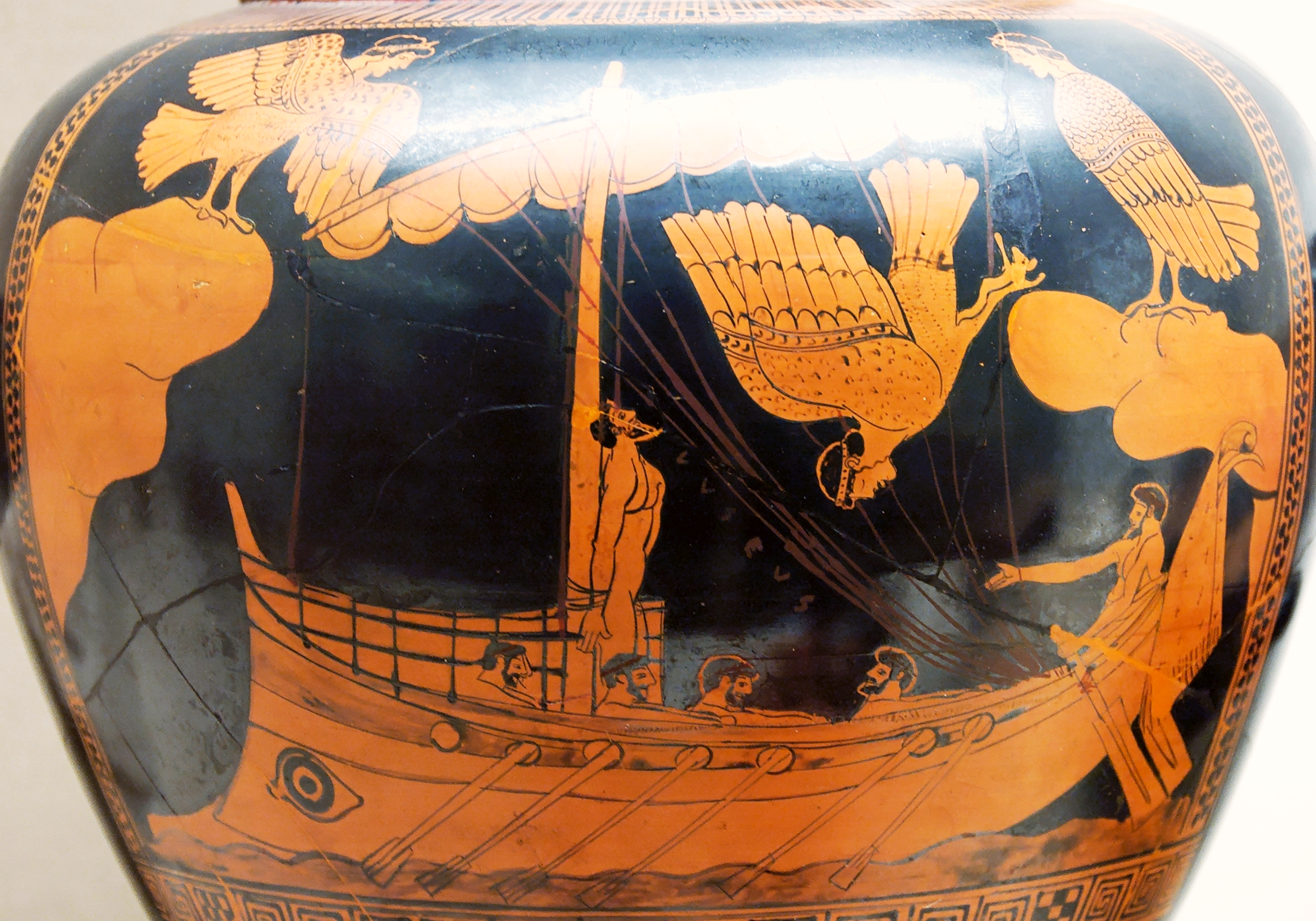
Odysseus and the Sirens, on an Attic red-figure stamnos from about 480–470 BC, by the artist called the Siren Painter after this very pot. Photo Jastrow, public domain, via Wikimedia Commons.
The Odyssey (Homer)
What it took directly
- documentedThe Odyssey in English comes from George Chapman's translation, around 1615, the first of some 60"Since the “Odyssey” first appeared in English, around 1615, in George Chapman’s translation," Wyatt Mason, The New York Times Magazine, Nov. 2, 2017
- documentedEmily Wilson's Odyssey (2017) comes from Emily Wilson, the first woman to translate the poem into English"Wilson, whose own translation appears this week, has produced the first English rendering of the poem by a woman." Wyatt Mason, The New York Times Magazine, Nov. 2, 2017
- statedWilson's first line, “Tell me about a complicated man” took from Homer's fifth word, polytropos, rendered as a plainly modern word"I wanted to make it a markedly modern term in a way that ‘much turning’ obviously doesn’t feel modern or like English." Emily Wilson, to Wyatt Mason, The New York Times Magazine, Nov. 2, 2017
What it learned to do
- statedEmily Wilson's Odyssey (2017) answered earlier translators' “maidservants” for the Greek dmoai, the enslaved women of the palace"which Wilson calls “an entirely misleading and also not at all literal translation,”" Wyatt Mason, The New York Times Magazine, Nov. 2, 2017, quoting Wilson
- documentedEmily Wilson's Odyssey (2017) learned from iambic pentameter, which Mason hears running through it as naturally as speech"the lines feeling not as if they were being fed into iambic pentameter because of some strategic decision but because the meter was a natural mode for its speaker." Wyatt Mason, The New York Times Magazine, Nov. 2, 2017
- documentedThe Odyssey's epithets (“wine-dark sea”, “gray-eyed Athena”) learned from the stock phrases, or formulas, that oral poets kept ready"Through his analysis of Homeric epithets - such as "divine Odysseus," "wine-dark sea," or "gray-eyed Athena" - he demonstrated that Homer's language was a total structure built up from stock phrases he called "formulas."" Milman Parry's argument, as set out by Twyla Gibson for the McLuhan Program, University of Toronto
The tradition it sits in
- documentedThe Odyssey (Homer) comes from a long tradition of oral poets who composed without writing"His reply was that Homer was "one of a long tradition of oral poets that . . . composed wholly without the aid of writing."" Milman Parry's argument, as set out by Twyla Gibson for the McLuhan Program, University of Toronto
- inferredThe Odyssey (Homer) comes from the same kind of sung, improvised epic as the Serbo-Croatian songs of the Yugoslav guslari"tested theories developed from the ancient manuscript tradition by comparison with the Serbo-Croatian oral epics of the Yugoslav guslari." inferred — Parry and his assistant Albert B. Lord tested the theory by comparing Homer with the epics of Yugoslav singers; a comparison supports the oral-tradition reading, it does not trace a line of descent
Where the whole form comes from
- documentedThe Odyssey (Homer) comes from Homer, whom Herodotus placed no more than four hundred years before his own time"for I suppose Hesiod and Homer flourished not more than four hundred years earlier than I" Herodotus, Histories 2.53 (A. D. Godley's 1920 translation, Perseus Digital Library)
Start here