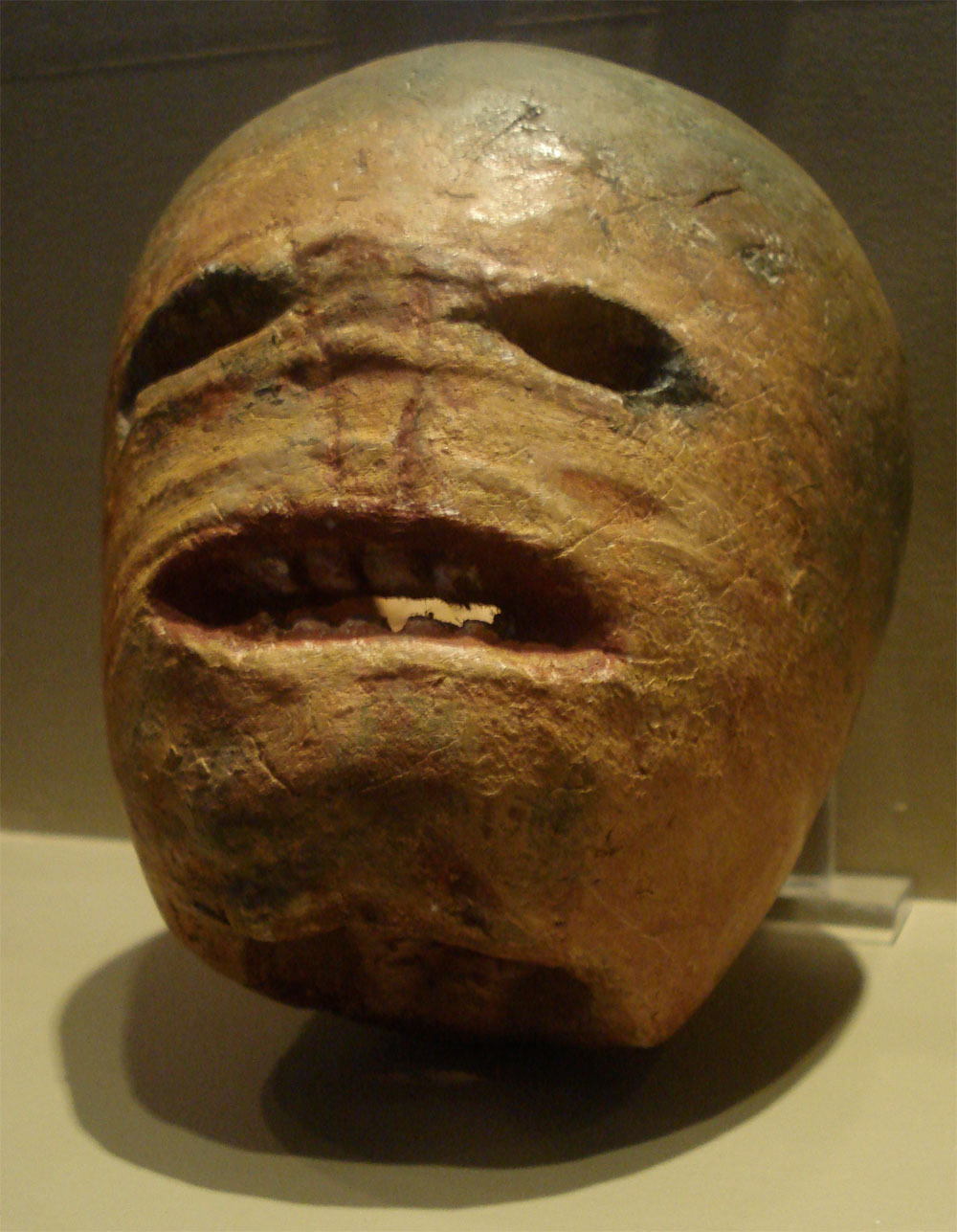
Before the pumpkin: a traditional Irish turnip jack-o'-lantern from the early 20th century, at the Museum of Country Life, Ireland. Whoever carved it is not named. Photo Rannpháirtí anaithnid at English Wikipedia, CC BY-SA 3.0, via Wikimedia Commons.
The jack-o'-lantern
What it took directly
- documentedThe American pumpkin jack-o'-lantern took from Irish emigrants who carved turnips at Hallowe'en and carried the custom to America"In Ireland, people cut out heads and faces of turnips and hid them in the hedgerows as a prank during Hallowe'en and they would have carried the tradition over to America." Rachel Craig, interpreter at the Ulster American Folk Park, to BBC News NI (Julian Fowler, 2005)
- documentedThe American pumpkin jack-o'-lantern took from the North American pumpkin, which carved better than a turnip or a potato"They discovered that pumpkins, not indigenous to Ireland but common in North America, were much better suited to carving than turnips or potatoes." National Geographic (Blane Bachelor, 2020)
- documentedThe jack-o'-lantern in American culture took from Washington Irving's "The Legend of Sleepy Hollow" and its Headless Horseman"Washington Irving’s “The Legend of Sleepy Hollow,” first published in 1820 and republished in 1858, propelled the pumpkin into American culture like never before." National Geographic (Blane Bachelor, 2020)
What it learned to do
- statedThe pumpkin jack-o'-lantern learned from New England boys carving faces into harvest pumpkins, as John Greenleaf Whittier remembered his own boyhood"When wild, ugly faces we carved in its skin, Glaring out through the dark with a candle within!" John Greenleaf Whittier (1807–1892), "The Pumpkin", a poem now in the public domain (poets.org)
- documentedThe carved turnip lantern learned from Worcestershire peasant boys' "Hoberdy's Lantern": a hollowed turnip with a carved face and a candle stump"In my juvenile days I remember to have seen peasant boys make, what they called a " Hoberdy's Lantern," by hollowing out a turnip, and cutting eyes, nose, and mouth therein" Jabez Allies, recalling his own childhood in The British, Roman, and Saxon Antiquities and Folk-Lore of Worcestershire (2nd ed., London, 1856)
- documentedThe carved vegetable lantern learned from households that could not afford metal lanterns and hollowed out root vegetables instead"Metal lanterns were quite expensive, so people would hollow out root vegetables" Nathan Mannion, senior curator, EPIC The Irish Emigration Museum, Dublin, to National Geographic (2020)
- inferredThe turnip lantern set on a hedge took from the will-o'-the-wisp: boys making a false night-light to frighten travellers"they used to place it upon a hedge to frighten unwary travellers in the night" inferred — Allies files the boys' turnip "Hoberdy's Lantern" in his chapter on the ignis fatuus, under the name his district gave those marsh lights, and both frightened people out at night; he does not say the boys were copying the lights
The tradition it sits in
- documentedThe jack-o'-lantern comes from the large turnips of Celtic Europe, hollowed, carved with faces and set in windows at Halloween"Pumpkins carved as jack-o-lanterns would not have been part of traditional Halloween festivals in Celtic Europe, since pumpkins are New World plants, but large turnips were hollowed out, carved with faces and placed in windows to ward off evil spirits." Bettina Arnold, co-director of the Center for Celtic Studies, University of Wisconsin–Milwaukee, Halloween lecture (2001)
- documentedThe name "jack-o'-lantern" comes from the ignis fatuus, the flickering marsh lights also called will-o'-the-wisp"Also known as fool’s fire, fairy lights, will-o’-the-wisp, and eventually, jack-o’-lantern" National Geographic (Blane Bachelor, 2020)
- documentedThe name "jack-o'-lantern" comes from 17th-century Britain's "Jack" for any man whose name you didn't know, such as a night watchman with a lantern"A night watchman, for example, became known as “Jack-of-the-Lantern,” or jack-o’-lantern." National Geographic (Blane Bachelor, 2020), citing Merriam-Webster
- documentedThe jack-o'-lantern comes from the Irish folk tale of Stingy Jack, the blacksmith who tricked the devil"According to folklore, the Jack O'Lantern is named after a blacksmith Stingy Jack who tricked the devil into paying for his drinks." BBC News NI (Julian Fowler, 2005)
- inferredThe American pumpkin jack-o'-lantern comes from two streams, not one: New England harvest carving as well as the Irish turnip custom"Irish immigrants, fleeing the potato famine in the 1840s, took Halloween to the US, where it was embraced." inferred — Whittier (born 1807, per poets.org) remembers carving pumpkin faces as a boy, and the BBC dates the Irish arrival with Halloween to the famine emigration of the 1840s; neither source says how the two met
Where the whole form comes from
- documentedThe jack-o'-lantern's Halloween night comes from Samhain, when the Celtic world held that the mounds of the dead opened"The mounds of the dead - the sidh in Irish - are thought to open on Samhain." Bettina Arnold, Center for Celtic Studies, University of Wisconsin–Milwaukee, Halloween lecture (2001)
- documentedThe carved face comes from pre-Christian Celtic head veneration, possibly"It may even have had pre-Christian origins that evolved from the custom of head veneration, or potentially even represented war trophies taken from your foes" Nathan Mannion, senior curator, EPIC The Irish Emigration Museum, to National Geographic (2020), hedged by him as a "may"
Start here