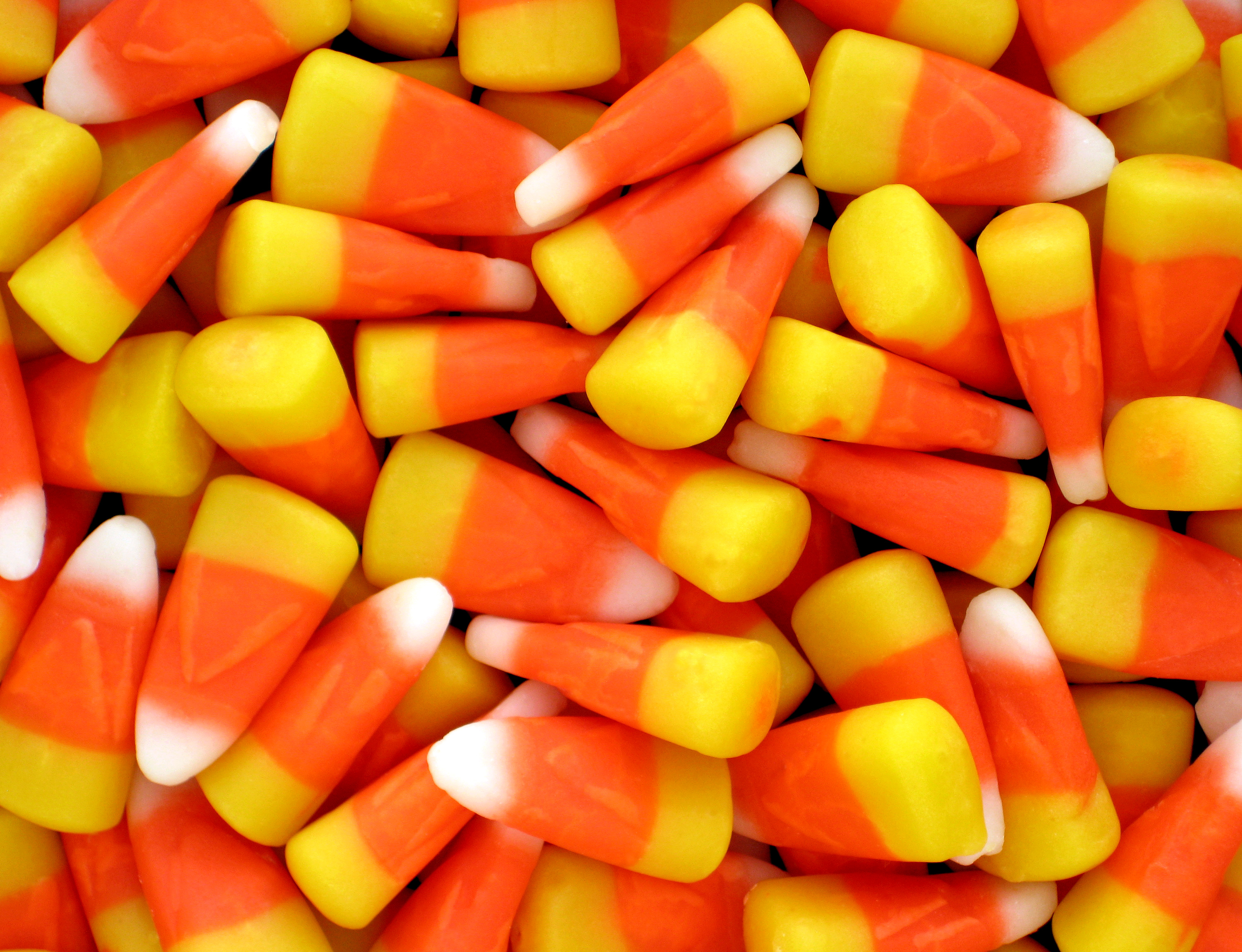
Candy corn, here Brach's. Photo Evan-Amos, public domain, via Wikimedia Commons.
Candy corn
What it took directly
- documentedCandy corn took from George Renninger, a Wunderle candy maker in Philadelphia, who originated "chicken corn" as part of the firm's 1888 Butter Cream line"Renninger collaborated with Wunderle to produce the third Wunderle product-the original “Butter Cream” in 1888." Fred Wunderle, son of the firm's founder, as told to the Confectioners Journal (September 1946), reprinted by the Wunderle family
- documentedCandy corn as a national brand took from the Goelitz Confectionery Company (now Jelly Belly), which bought the recipe in 1898 and sold it as "Chicken Feed""Another company, the Goelitz Confectionery Company—now known as the Jelly Belly Candy Company—bought the recipe in 1898 and sold it as "Chicken Feed."" Smithsonian.com (Danny Lewis, 2015)
- documentedCandy corn as a Halloween candy took from the 1950s, when Halloween came to be dominated by candy and October advertising of candy corn spiked"As Halloween became more and more dominated by candy beginning in the 1950s, candy corn increasingly became the candy for Halloween." Samira Kawash, The Atlantic (2010)
What it learned to do
- documentedCandy corn learned from George Renninger's craft of conceiving and carving moulds, for which the Wunderle line was known"an exceptionally able confectioner who, throughout the remainder of his busy life, showed exceptional artistic talent and originality in conceiving and carving unique molds" The Confectioners Journal (September 1946), on the Wunderle firm's history, reprinted by the Wunderle family
- documentedCandy corn learned from the "stringers": men who walked backwards pouring the hot slurry by hand into kernel-shaped moulds"men dubbed stringers walked backwards, pouring the hot concoction into a tray of molds in the shape of corn kernels." TIME (Olivia B. Waxman, 2013)
- documentedCandy corn learned from layering three colours by hand, the one real innovation over other butter creams"The real innovation in candy corn was the layering of three colors. This made it taxing to produce (all those colors had to be layered by hand in those days)." Samira Kawash, The Atlantic (2010)
- inferredWunderle's candy corn learned from the starch-based candy making Philip Wunderle, a German immigrant, learned at Philadelphia's Sundermeyer Candy Company"For a starter he learned to make gum drops at Sundermeyers using starch as a base instead of the traditional hard and chewy gum arabic." inferred — the 1946 Confectioners Journal says Wunderle learned to make gumdrops on a starch base at Sundermeyer's, and TIME describes candy corn made in corn-starch moulds; neither source connects the two
The tradition it sits in
- documentedCandy corn comes from the 1880s fashion for "butter cream" candies moulded into chestnuts, turnips and clover leaves"At that time, many candy makers were producing "butter cream" candies molded into all kinds of natural or plant-inspired shapes, including chestnuts, turnips, and clover leaves." Samira Kawash, The Atlantic (2010)
- documentedCandy corn comes from a confectioners' bid for a largely rural, farming America"As Chicken Feed, candy corn was intended to appeal to Americans' largely agricultural roots." Rebecca Rupp, National Geographic, quoted by Smithsonian.com (2015)
- documentedCandy corn comes from penny candy: cheap, sold in bulk, eaten all year by children"Through the first half of the 20th century, candy corn was first and foremost a variety of "penny candy," those inexpensive candies sold in bulk, primarily for children." Samira Kawash, The Atlantic (2010)
- inferredThe name "candy corn" comes from a candy first called "chicken corn" at Wunderle and "Chicken Feed" at Goelitz"In the early days, not everybody called it "candy corn." Some people called it chicken feed." inferred — the 1946 Confectioners Journal records "chicken corn" and Smithsonian records "Chicken Feed"; Kawash says not everyone called it candy corn early on; no source dates the change of name
Where the whole form comes from
- documentedCandy corn comes from feed corn: before the First World War, Americans thought of corn as food for pigs and chickens"Corn was coarse and cheap and not very tasty: good food for pigs and chickens." Samira Kawash, The Atlantic (2010)
Start here