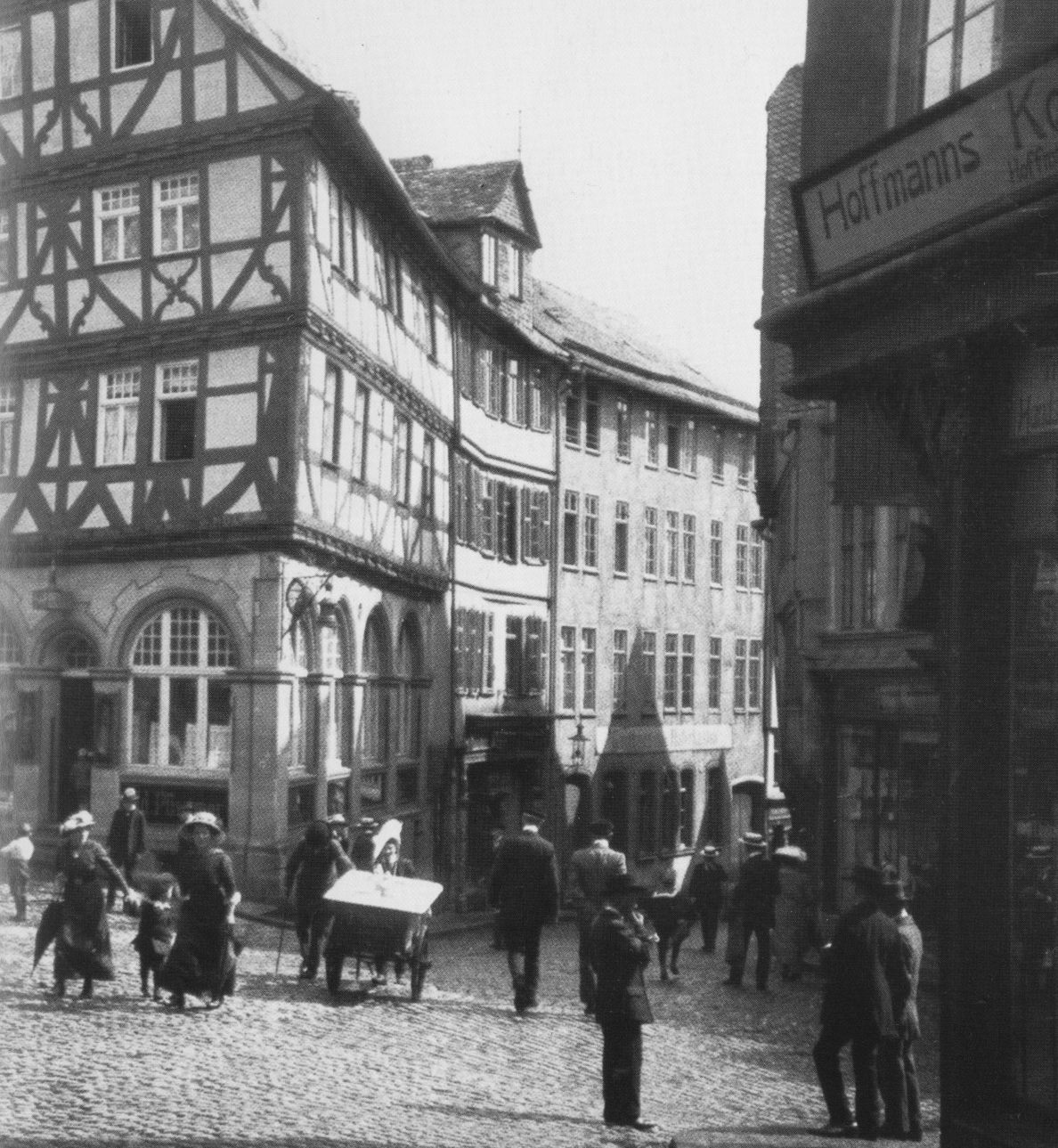
Wetzlar in 1914, photographed by Oskar Barnack, the Leitz engineer who built the Ur-Leica. Public domain, via Wikimedia Commons.
35mm film
What it took directly
- documentedThe 135 cartridge took from August Nagel's daylight-loading cartridge for the Kodak Retina"Both the Retina camera and the daylight loading cartridge were invented Dr August Nagel, Kodak bought Nagel's company in 1931 and began production of the Retina in 1934." Science Museum Group, object record for the Kodak Retina (Type 117)
- documentedThe name "135" took from a suggestion to call the new 35mm magazine 135, not 131, for its width"Someone suggested using 135 rather than 131 because it was 35mm fllm." The Photographic Historical Society (Rochester, N.Y.), newsletter, December 2001
- statedThe Ur-Leica took from 35mm cinema film, turned on its side"It was the first camera to use 35 mm cinema film in landscape format." Leica Camera AG, "The History of the Leica I"
- statedThe Leica I took from Ernst Leitz II's decision to risk series production"Ernst Leitz II drew a line under discussions with his famous statement “I hereby decide: we will take the risk.”" Leica Camera AG, "The History of the Leica I"
- documented35mm motion-picture film took from the Eastman Company's celluloid, which Dickson bought in large quantities"The Eastman Company later produced its own celluloid film which Dickson soon bought in large quantities." Library of Congress, "Origins of Motion Pictures" (drawing on Charles Musser, David Robinson and Eileen Bowser)
What it learned to do
- statedOskar Barnack learned from his job running cinema-technology development at Leitz"From 1911, Oskar Barnack worked at Leitz, first as a precision mechanic and shortly afterwards as Head of Development for cinema and measuring technology." Leica Camera AG, "The History of the Leica I"
- documentedEdison's motion-picture work learned from Étienne-Jules Marey's continuous roll of film"In Europe Edison had met French physiologist Étienne-Jules Marey who used a continuous roll of film in his Chronophotographe to produce a sequence of still images" Library of Congress, "Origins of Motion Pictures"
The tradition it sits in
- documentedThe 35mm still camera comes from a crowd of cine-film cameras built before the Leica"There were a number of 35mm still cameras using perforated movie film prior to the Leica. The first patent for one was issued to Leo, Audobard and Baradat in England in 1908." Corsopolaris, "List of Early 35mm Cameras, from 1914 to 1932" (a collector's survey; it disputes the Leica's "first")
- documented135 film comes from Kodak's numbered roll films"This table gives the Kodak roll film sizes in the order they were introduced. These film numbers were not allocated or used until 1913." The Brownie Camera Page, "The History of Kodak Roll Films"
- inferredThe 135 cartridge comes from the film cassettes Leica and Contax users were already reloading"At the same time it was decided to number the film for the Contax camera and reloads for the Leica permanent cassette." inferred — the Photographic Historical Society shows Kodak numbering reloads for the Contax (235) and the Leica's permanent cassette (435) in the same decision that named 135, and calls the cartridge idea's origin "vague"; the Science Museum credits August Nagel. That the 135 gathered up an existing cassette habit is our reading
Where the whole form comes from
- documented35mm film comes from Edison's Kinetoscope, whose patent set the width at 35mm"Edison's Kinetoscope, open. Film was threaded on rollers as a continuo us ribbon. In this patent, the width of the film was specified as 35mm, and allowance was made for the possible use of a cylinder." Library of Congress, "Origins of Motion Pictures"
- statedThe small 35mm camera comes from Oskar Barnack's asthma, which kept him from carrying the heavy cameras of his day"He was an amateur photographer, but due to his asthma was unable to carry cameras, which were large and heavy back then." Leica Camera AG, "The History of the Leica I"
Start here